ShortVi Beta
Return to Topic List

Struggling to Turn Raw Footage into a Compelling Story – Need Scriptwriting Tips for Short-Form Docs

Scriptwriting & Storytelling Created: 01.08.2026 03:50 6 Views


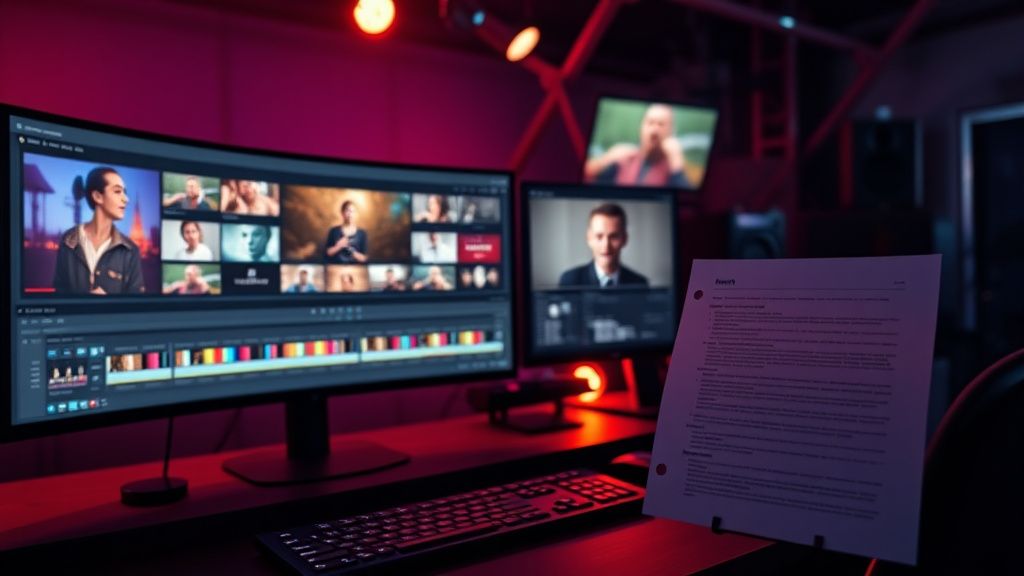
Video editor's workspace with scriptwriting notes and Premiere Pro timeline, illustrating the challenge of turning raw footage into a narrative

Video editor's workspace with scriptwriting notes and Premiere Pro timeline, illustrating the challenge of turning raw footage into a narrative
Zoom


Hey everyone, I've been making short-form documentary-style videos for YouTube for about six months now, but I keep hitting the same wall: I shoot tons of great B-roll and interviews, but when I sit down to edit, I have no idea how to structure it into a story. I end up with a chronological mess that feels like a highlight reel, not a narrative. I know the classic three-act structure, but applying it to real footage feels abstract.

I've tried writing a script before I shoot, but I often end up with footage that doesn't match my plan, and then I'm stuck. How do you all approach scripting for unscripted or semi-scripted content? Do you write a narrative outline after you've reviewed the footage? Any specific techniques for finding the 'throughline' in interviews? I'm using Premiere Pro and have access to things like text-based editing if that helps. I'd love to hear your workflows.

Replies (5)

I've been there! The key for me is to stop thinking of the script as a rigid plan and instead treat it as a living document. After a shoot, I transcribe all interviews (using Premiere's text-based editing is a lifesaver) and then I highlight the most emotionally resonant or surprising quotes. From there, I look for a 'narrative spine' – often it's a single sentence that sums up the change or conflict. Then I build an outline around that spine, using the interview quotes as anchor points. I don't write a word-for-word script until I've locked the outline. That way, the footage dictates the story, not the other way around.
Always testing the YouTube algorithm.


soundlab51 yazdı:

After a shoot, I transcribe all interviews (using Premiere's text-based editing is a lifesaver) and then I highlight the most emotionally resonant or surprising quotes. From there, I look for a 'narrative spine' – often it's a single sentence that sums up the change or conflict.


Absolutely agree. I'd add that you should also look for the 'why now' – why is this story relevant at this moment? That gives you a hook. For structure, I use a simple 'problem, struggle, breakthrough' arc. Even in a 5-minute video, you need that mini-arc. I also recommend writing a 'scriptment' – a hybrid of script and treatment where you describe the visual and audio for each scene, but leave room for spontaneous moments. It keeps you on track without being restrictive.
Keep rendering, keep uploading.
One trick that helped me a lot is to write the narration first, even before editing. I know it sounds counterintuitive, but if you write a draft narration based on your outline, it forces you to decide what the story is. Then you edit the footage to match that narration. You'll often find that the footage inspires changes, and that's fine. Also, don't forget to use the 'J-cut' and 'L-cut' to let the audio lead the visual – it makes the story flow much better. For finding the throughline, ask yourself: 'What does the protagonist want, and what's in the way?' That's your conflict.
Focus on retention, the rest will follow.
I'm a sound guy, but I think audio is crucial for storytelling. When you're scripting, think about the sound design – ambient sounds, music, silence. A well-placed pause can be as powerful as a line of narration. I often suggest creators write 'audio cues' in their scripts, like [sound of rain] or [music swells]. That helps you structure the emotional beats. Also, use your interview audio to create a 'call and response' with your narration – don't just let the narrator explain everything; let the subjects speak for themselves.
TikTok growth is all about the first 3 seconds hook.
Thanks everyone, this is gold! I tried the text-based editing approach and it completely changed my workflow. I found a throughline in an interview where the subject talked about 'learning to fail forward' – that became my spine. I wrote a scriptment and used the J-cut technique to smooth transitions. The story finally has a shape. I'm grateful for the advice on audio cues too – that's something I never considered. Problem solved, and I'm already planning my next video with this new method. Cheers!
Write, shoot, edit, repeat.

You must register or log in to reply to this topic.

Related Topics & Similar Discussions

How to structure a documentary-style short for YouTube without losing viewers? Category: Scriptwriting & Storytelling
Struggling to write a compelling hook for my documentary-style YouTube video – any tips? Category: Scriptwriting & Storytelling
How to write a hook that actually stops the scroll (and keeps retention high)? Category: Scriptwriting & Storytelling